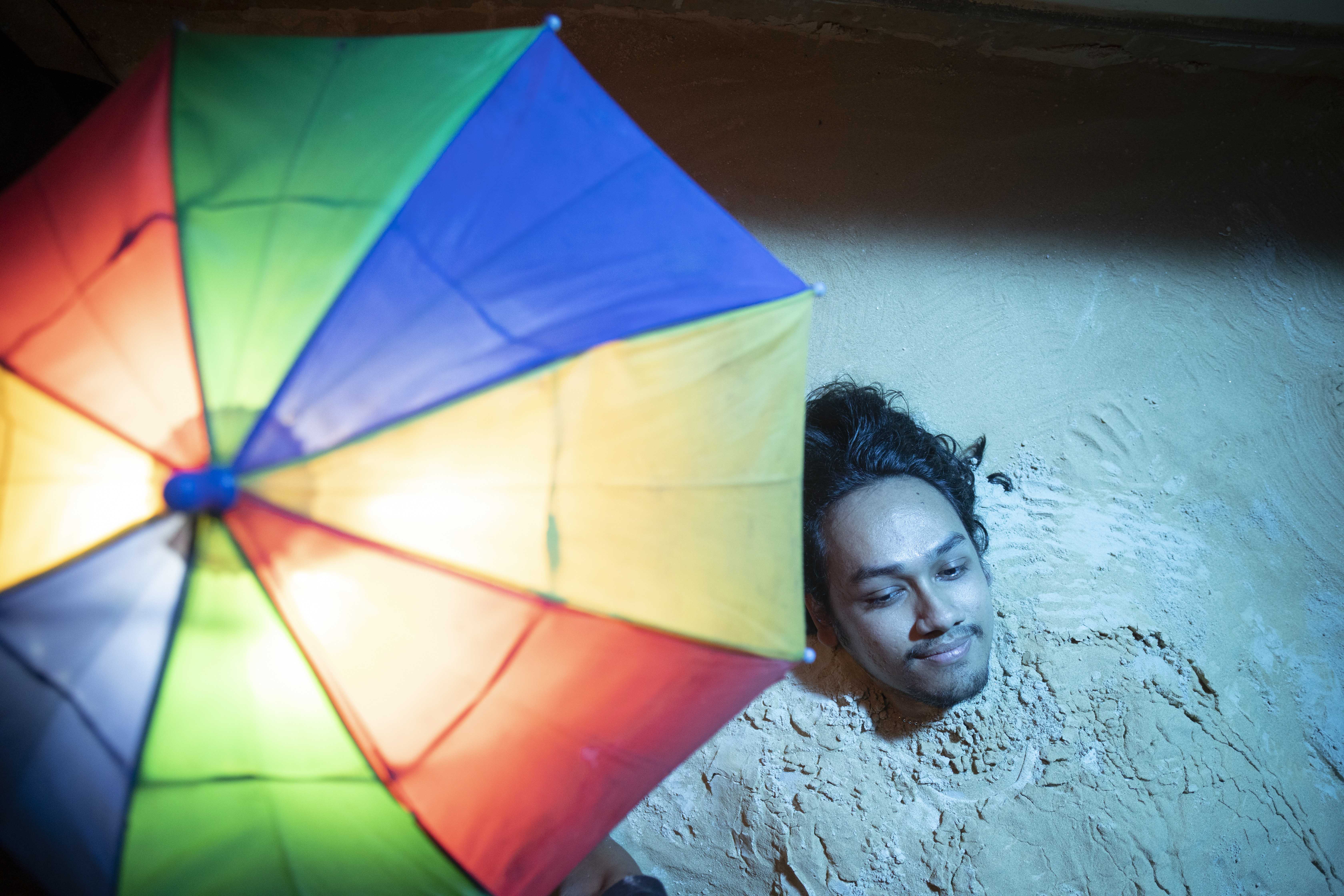
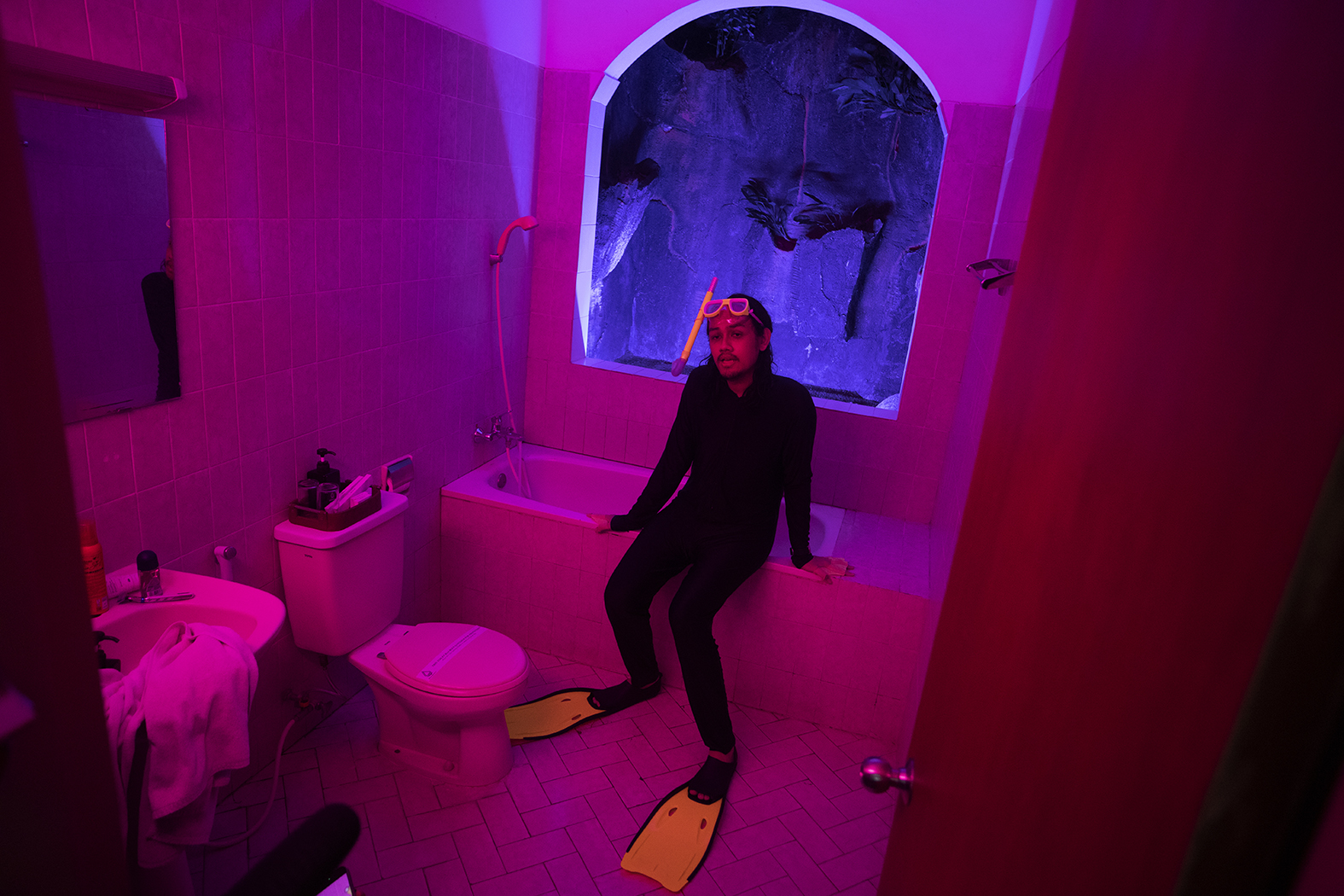
Macho Mystic Meltdown. Chapter 1: Oikoumenē — Commissioned by MUNCH Triennale 2025
Premise:
In the 90s, my father was stranded at sea, missing for several days. Just when our family had lost hope, all of a sudden he returned home. Listening to his account of being lost at sea felt like hearing about a psychedelic trip—a surreal narrative that blurred the boundaries between reality and imagination.
For years, my father lived in his own world. He never worked, relying entirely on my mother—the sole breadwinner—for everything. He became a hoarder, collecting objects that most people would consider rubbish. His beliefs were equally eclectic: he subscribed to various religions and a range of conspiracy theories, for example, the story of a Kiai who embraced three religions after sighting an alien. While he was sceptical of Minahasan ancestral teachings, he embraced aspects of the Abrahamic faiths. He read the Bible and the Qur’an, ate unleavened bread, and even practised Reiki. At times, he was a hypochondriac, and paradoxically also an extreme machoist who experimented with necromancy, attempting to contact via phone call another deceased brother through his surviving sibling.
This video work is a study of a character who exists on the boundary between the real and the virtual—a figure whose perception of the world fuses what he considers factual with the vivid fabrications of his imagination. He is a character who never separates myth from actuality; he is the man who raised me and whose life resembled a strange, ongoing psychedelic journey.
Through the world-building approach I typically use in my works, this project will explore deeply into his universe, presenting a mosaic of unique perspectives and narratives. It aims to critically capture the essence of a life lived on the fringes of reality, exploring themes of personal politics, memory, belief, and the enigmatic interplay between fact and fiction. This work seeks not only to honour the complexity of his character but also to invite people to question the boundaries of what is real and what is imagined.
Work Description
My interest in examining this topic is rooted in an empirical observation of my father’s behaviour. His cognitive framework appears to operate within a reality of its own, functioning as a form of continuous ‘worldbuilding’, wherein he creates and recreates possible realities. In Indonesian society, such practices of ongoing worldbuilding and the fictionalisation of realities are not uncommon: many Indonesians grow up within a socio-cultural milieu that continually promises new ideologies, objectives, or goals. For instance, during the early formation of the state, Indonesian society was presented with feudalistic ideals, followed by the introduction of colonial ideologies in both religious and governmental forms, and later confronted by capitalism and, more recently, neo-liberalism in the 21st century.
These constant ideological shifts, each purporting to deliver transformative promises that never fully materialised, often mean that many Indonesians lack autonomy over their own lives. As a result, in order to survive and maintain mental stability, individuals frequently develop their own ‘worlds’.
My father is the quintessential example par excellence of this phenomenon. One of his most idiosyncratic habits—integral to his tendency to construct his own world—is his propensity to hoard unnecessary items. He maintains that this behaviour provides him with a sense of comfort, as if he were creating his own kingdom out of objects he does not require. It is almost akin to a salvagepunk practice—a coping mechanism in response to a socio-political climate that marginalises him. This mental issue is also clearly evident in his daily life, which is marked by hypochondria. He is particularly inclined towards the use of pharmaceutical substances to safeguard himself against bacteria, viruses, and any other diseases. It is indeed ironic to consider that the tendencies for hoarding and hypochondria can coexist within the same mind.
By engaging with this work and presenting an observational study of my father, I seek to illuminate the interconnections among several ostensibly disparate elements: the practice of worldbuilding, the struggle for survival in the Indonesian context, mental health, pharmacology, ‘weird science’, and the parent–child relationship. My aim is to draw critical attention to how these elements resonate with, inform, and complicate one another, thereby offering a more nuanced understanding of the lived realities they produce.